


“Uniqueness is the most valuable asset. And at the same time the only one you can’t simply buy.”
What makes a hotel distinctive?
Three hotels, three completely different answers.
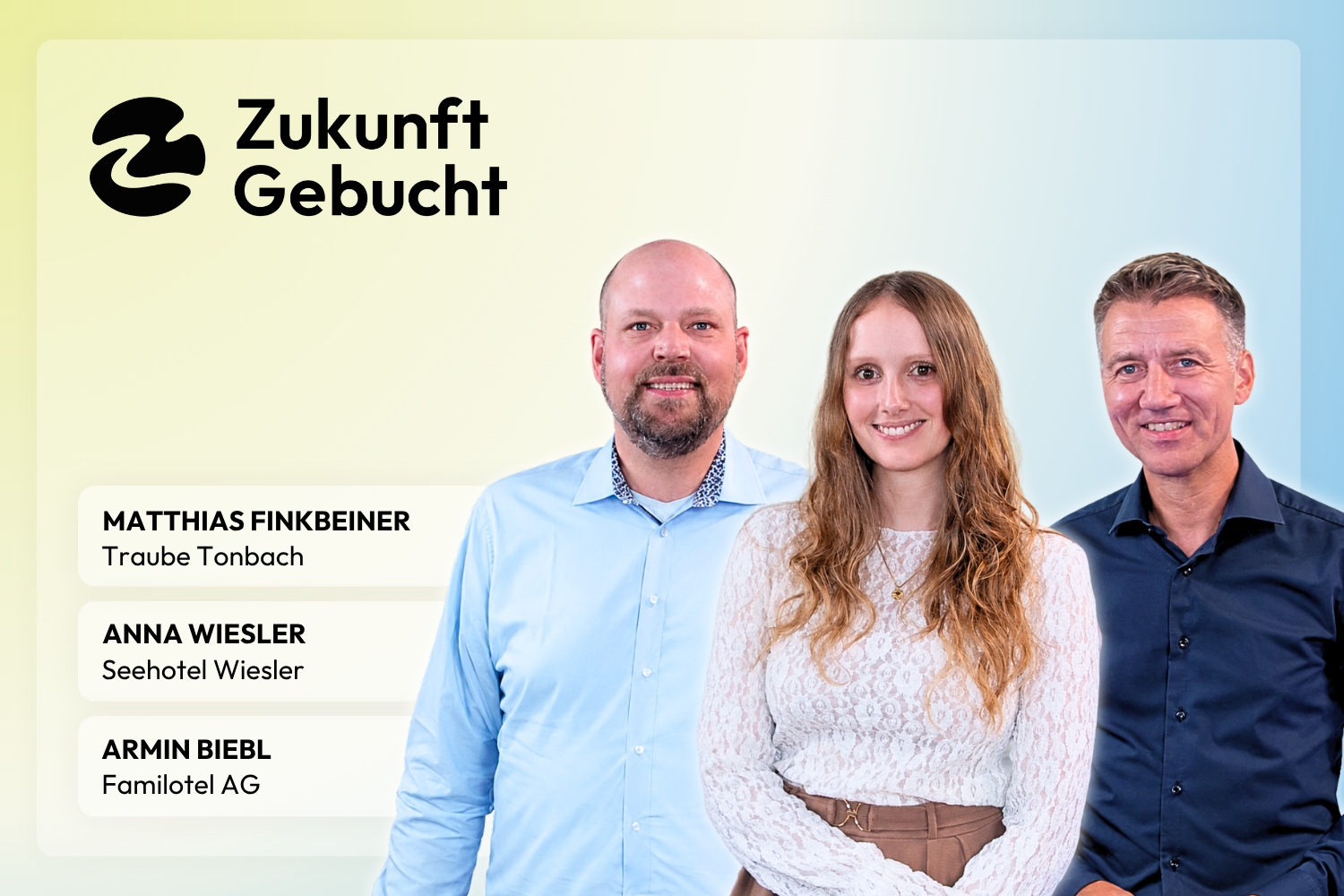
Anna Wiesler, junior manager at Seehotel Wiesler on Lake Titisee, deliberately focuses on a narrow target group: couples and wellness seekers. No conferences, no coach tours, no tour groups. For her, distinctiveness comes from what the hotel leaves out, not from what it adds. On top of that comes a strong connection to the Black Forest region: its own hunting grounds, its own coffee roastery, homemade cake, its own cosmetics line. And a conscious decision against booking platforms: the hotel can only be booked via its own website.
Armin Biebl, board member of Familotel AG, leads a community of more than 60 owner-managed family hotels. For him, distinctiveness isn’t the water park or the climbing tower, but the feeling of being seen and addressed by name. Familotel deliberately doesn’t put a uniform stamp on its hotels; each one keeps its own individual identity.
Matthias Finkbeiner, one of the owners of Traube Tonbach, whose Schwarzwaldstube has held three Michelin stars without interruption since 1992. A family business for more than 230 years, three stars held through generational change and even through a fire. How the team has maintained that level for 30 years, more on that later.
Can distinctiveness be scaled?
The clear answer from the panel: no, at least not as a copy. At Familotel, every host family is different, each has its own spirit. What scales is not the individual experience, but the shared promise: standards for core points such as childcare, but freedom for individual execution in each hotel.
Technology: amplifier or threat to identity?
All three agree here, with different nuances. A hotel’s product remains service delivered by people; technology doesn’t create distinctiveness. But it can clear the way to it. At Seehotel Wiesler, a Phone AI has recently started taking over the phone at night, answering simple questions and guiding callers to booking, where previously only the answering machine ran.
“People come for people. Technology serves the purpose of putting them at the center.”
The common denominator: technology should take over routine tasks so there is more time for the guest, not replace direct contact.
Where process optimization reaches its limits
A hotel is not an industry with perfectly repeatable processes. Every arrival is different, because every guest is different.
“The more checklists you have, the less goes wrong. But the less distinctive you are, too.”
One concrete risk: guests misunderstanding the brand promise. Traube Tonbach experienced this first-hand during the pandemic, with guests who didn’t know the hotel’s concept and complained about things that were never offered there.
The full story
What comes next is the most exciting part of the episode: the one-on-one interview with Matthias Finkbeiner on how a three-star team has stayed at world-class level for 30 years, and a deep dive into value-based pricing: why a hotel’s real competition is rarely the hotel next door, and what that means for your own pricing.
You won’t find that here on the blog, only in the full episode.
Watch episode 1 of Zukunft gebucht now→
Don’t want to miss an episode? Follow Zukunft Gebucht on LinkedIn, Instagram and Facebook: @zukunftgebucht
___
About the Hosts
RateBoard
RateBoard develops revenue management software for hotels. The system analyzes booking data, demand and market prices and automatically calculates the best room rates. This helps hotels grow revenue and spend less time on pricing. RateBoard has been on the market for over ten years and is part of the Zucchetti Group.
DialogShift
DialogShift is a Berlin-based software company for AI-powered guest communication in hospitality. With Chat AI, Phone AI, Email AI and Journey Messaging, hotels answer guest requests around the clock on every channel, increase direct bookings and take workload off their teams.
.png)